
BITUS JOURNAL · Dropshipping Guides
How to Choose a China Dropshipping Agent: 10 Criteria
How to choose a China dropshipping agent: 10 criteria covering shipping speed, quality control, MOQ, pricing, communication, integrations, and branding.
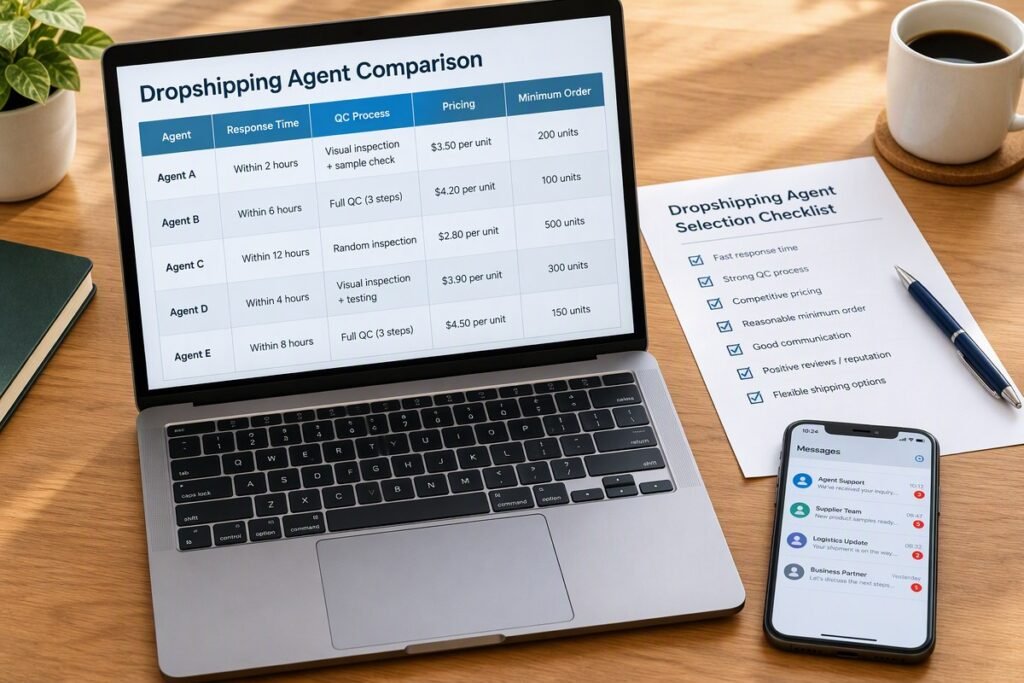
Your dropshipping agent controls the two things your customers actually experience: product quality and delivery speed. Choose a China dropshipping agent by scoring candidates against 10 criteria — shipping speed, quality control, MOQ policy, pricing transparency, communication, platform integrations, private-label capability, returns policy, warehousing terms, and verifiable track record. The right agent fits your current order volume and your growth plan, not just your budget.
The wrong choice costs you in chargebacks, bad reviews, and weeks lost switching agents mid-scale. Below are the 10 criteria that matter, the exact questions to ask, and the red flags that should make you walk away.
Why does the agent matter more than the product?
In dropshipping, you never touch the product. Your agent sources it, stores it, inspects it, packs it, and ships it — which means every customer touchpoint after checkout is in your agent’s hands. A great product with a bad agent still produces bad reviews; an average product with a great agent can still build a brand.
Most sellers compare agents on unit price alone — a mistake. A $0.30 cheaper unit cost means nothing if 8% of orders arrive defective or take 25 days to arrive.
What are the 10 criteria for choosing a China dropshipping agent?
1. How fast is shipping to your markets?
Ask for real transit times to your top markets, broken down by shipping method. A serious agent offers multiple tiers: standard economy lines, faster special lines with tracking, and express couriers such as DHL or FedEx for urgent orders.
Typical 2026 ranges: standard China-to-US shipping takes 8–15 business days, special lines 5–10, and express couriers 3–5 at a much higher cost. Ask which carriers the agent uses — common ones include YunExpress, 4PX, USPS, DHL, FedEx, and UPS — and whether tracking is door-to-door or stops at the border.
Red flag: an agent that quotes only “7–12 days worldwide” with no breakdown by method or destination.
2. What is the quality control process?
This is the criterion most sellers underweight, and the one that destroys the most stores. Ask whether inspection covers every unit or only a random sample, what the checklist includes (appearance, function, dimensions, accessories, packaging), and what happens to failed units.
Full inspection on every order catches defects before they reach your customer; random sampling lets a percentage through by design. Ask whether you receive photos of QC failures and how fast defective stock gets replaced.
Red flag: “we check the products” with no documented process, or QC offered only as a paid add-on.
3. What is the MOQ policy?
If you are testing products, you need a low minimum for standard fulfillment — a handful of orders per day, not thousands of units. Private label and custom packaging will always carry an MOQ — that is normal — but it should be stated upfront, not discovered after you have designed your packaging.
Ask about three MOQs separately: standard fulfillment, custom packaging, and private label/OEM manufacturing. A beginner-friendly agent keeps the standard fulfillment minimum low — Bitus, for example, starts at 5 orders per day.
Red flag: MOQs hidden in fine print, or “no MOQ” claims that evaporate the moment you ask about branded packaging.
4. Is pricing transparent?
You should be able to get a written quote breaking down product cost, shipping cost, and fulfillment fee per order — before you commit to anything. Ask explicitly about setup fees, monthly fees, storage fees, and return-handling fees.
The healthiest pricing model for growing sellers is pay-per-order with no monthly retainer: you pay when you sell, and you pay nothing when you don’t. Be wary of agents whose quotes bundle everything into one opaque “service fee” you cannot decompose.
Red flag: refusal to provide itemized pricing, or fees that appear only on your first invoice.
5. How good is communication?
You will work with this agent every day. Ask the questions that determine your daily reality: do you get a named, dedicated agent or a shared ticket queue? What are the response-time expectations? Is there direct WhatsApp or email contact, and does coverage match your timezone?
A named agent who knows your products resolves problems in minutes; a ticket queue takes days. For most sellers, communication quality is the biggest predictor of a good agent relationship.
Red flag: contact form only, no direct messaging channel, or replies that take 48+ hours on business days.
6. Which platforms does the agent integrate with?
Manual order entry does not scale past a handful of orders a day. The agent should offer automatic order sync via API with your platform — Shopify, WooCommerce, Etsy, TikTok Shop, Amazon, and eBay are the common ones — plus tracking-number sync back to your store so customers stay informed.
Ask how long integration takes, and confirm all your sales channels are supported — not just Shopify.
Red flag: “send us a spreadsheet of your orders” as the primary workflow.
7. Can the agent support private label and branding?
Even if you start with generic dropshipping, you will eventually want branded packaging, thank-you cards, or full private label. Choosing an agent that only ships plain poly-mailers means switching agents later — exactly when switching is most painful, because you will be migrating at volume.
Ask what branding options exist today: custom boxes, stickers, hang tags, tape, inserts, and full OEM manufacturing. You do not need to use them on day one; you need the upgrade path to exist.
Red flag: no branding options at all, or branding “coming soon” with no timeline.
8. What is the returns and refund policy?
Things go wrong in e-commerce; what matters is who pays when they do. A fair policy is simple: if the agent makes the error — wrong item, wrong size or color, missing items, damage caused by packing — the agent reships free or refunds in full. For customer-initiated returns, the agent should at least provide a return address and a clear process.
Get this in writing — verbal refund promises are worth nothing in a real dispute.
Red flag: no written returns policy, or “all sales final” even on fulfillment errors.
9. What are the warehousing and storage terms?
If you hold inventory, ask about free storage periods, fees after that period, dashboard access to live inventory, and how stock counts get reconciled. Real-time inventory sync prevents overselling, which is one of the fastest ways to get marketplace listings suppressed or ad accounts flagged.
Red flag: no inventory visibility at all, or storage fees that kick in after an unreasonably short free period.
10. Can you verify their track record?
Ask for what you can check independently: how long they have operated, client testimonials, third-party reviews on Trustpilot or Google, and whether they will share references. Before signing anything, search “[agent name] + review” and “[agent name] + scam.”
No agent is perfect — judge them by how they respond to complaints, not just the star rating. Hundreds of reviews with thoughtful replies to negative ones beats twelve perfect reviews with no history.
Red flag: zero independent reviews, or a brand-new website with no verifiable company history.
Quick reference: what to ask and what to avoid
| Criterion | Ask this | Red flag |
|---|---|---|
| Shipping speed | Transit times by method and destination | One vague “7–12 days” for everywhere |
| Quality control | Full inspection or sampling? Documented checklist? | No documented QC process |
| MOQ | Separate MOQs for fulfillment, packaging, private label | Hidden MOQs in fine print |
| Pricing | Itemized written quote before committing | Opaque bundled fees |
| Communication | Named agent? Response time? Direct WhatsApp? | Contact form only |
| Integrations | API sync with your platforms + tracking sync | Spreadsheet-based workflow |
| Private label | Branding options available now | No branding upgrade path |
| Returns | Written policy; who pays for agent errors | No written policy |
| Warehousing | Free storage period, live inventory sync | No inventory visibility |
| Track record | Independent reviews, references | No verifiable history |
Score every candidate on this table. The highest honest score — not the lowest unit price — is usually the cheapest choice over twelve months.
How does Bitus help you choose the right agent?
Bitus is a Shenzhen-based dropshipping and private label fulfillment company built around the criteria above. Every client works with a named dedicated agent reachable by direct WhatsApp and email — not a ticket queue. Every order goes through full quality inspection, not random sampling, and units that fail inspection are returned to the factory before they can ship to your customer.
Dropshipping fulfillment starts at 5 orders per day, sourcing quotes are free, and there are no setup fees or monthly fees — you pay per order. Bitus connects Shopify, WooCommerce, Amazon, eBay and TikTok Shop through Dianxiaomi, plus Etsy via a shared Google Sheet, with automatic order sync for Dianxiaomi-connected stores, offers shipping to the US, Europe, South Africa, Mexico, Chile, Colombia, Turkey and Brazil via carriers including YunExpress, 4PX, USPS, DHL, FedEx, and UPS, and provides a full private label upgrade path with custom boxes, thank-you cards, stickers, hang tags, and tape. If Bitus makes an error — wrong item, size, color, missing items, or packing damage — it reships free or refunds in full. Run the ten questions in the table above against any agent you evaluate, Bitus included. See how Bitus fulfillment works.
To see these criteria applied to a specific alternative, read our Bitus vs Zendrop comparison.
FAQ
What is the most important criterion when choosing a dropshipping agent? Communication quality and quality control matter more than unit price. A named agent who responds quickly and a full-inspection QC process prevent the defects and delays that destroy stores.
How much should a China dropshipping agent cost? Most reputable agents charge per order with no monthly fees: product cost plus shipping plus a small fulfillment fee. Large setup fees or monthly retainers are uncommon in dropshipping fulfillment and worth questioning.
Should I choose an agent with a low minimum? Yes, if you are testing products or just starting out. A low minimum on standard fulfillment (Bitus starts at 5 orders per day) lets you validate products without inventory risk. Expect MOQs only for custom packaging and private label manufacturing.
How do I verify a dropshipping agent is legitimate? Check independent reviews on Trustpilot and Google, search the company name plus “review” and “scam,” ask for client references, and place a small test order before scaling up.
Can I switch dropshipping agents later? Yes, but it is disruptive — you must migrate product data, packaging specs, and integrations. Choosing an agent with a private label upgrade path from the start avoids a painful switch later.
Ready to work with an agent that answers all ten?
Get a free sourcing quote and talk directly with a Bitus agent about your products, markets, and volume. No setup fees, no monthly fees — just straight answers to the ten questions above. Get a free quote.
A good agent starts with the right products — browse our free October winning-product shortlist to see what our sourcing team flagged this month.
Tell us what you sell — get a sourcing & fulfillment quote within one working day.