
BITUS JOURNAL · Dropshipping Guides
What is Dropshipping? Complete Guide 2026
What is dropshipping in 2026? Learn how the no-inventory model works, real startup costs, pros and cons, best products, and how to launch your first store.
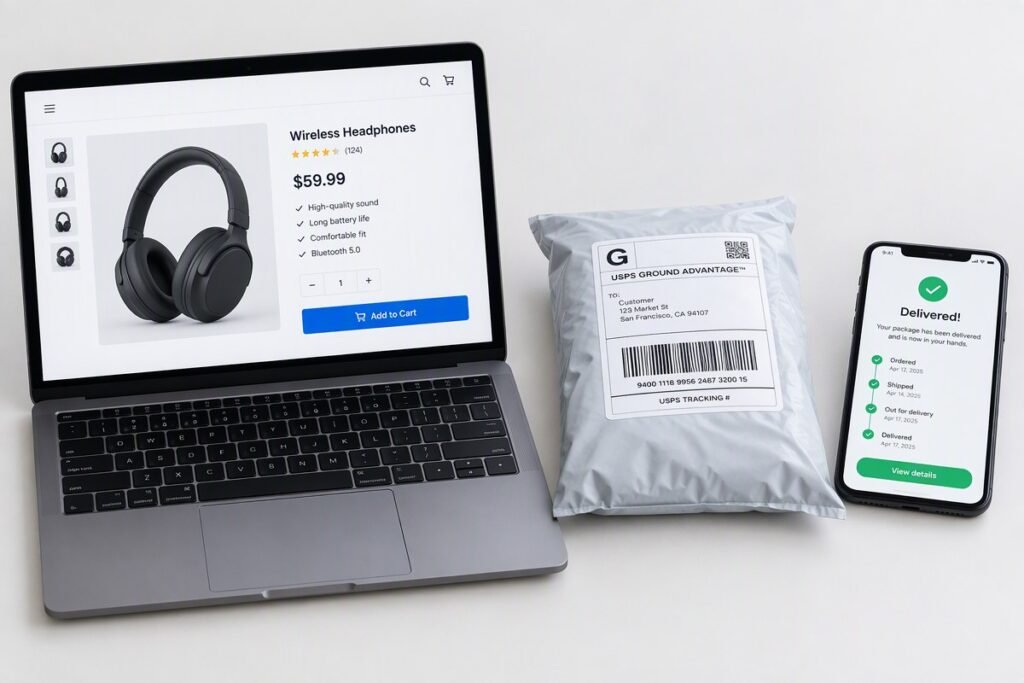
Dropshipping is a retail fulfillment model where you sell products online without holding any inventory. When a customer places an order in your store, your supplier or fulfillment agent ships the product directly to them — you never touch the goods.
In 2026, dropshipping remains one of the lowest-cost ways to start an e-commerce business. But the model has matured: success now depends on choosing the right products, working with a reliable fulfillment partner, and marketing effectively — not just listing cheap products and hoping for sales.
How does dropshipping work?
The process has five steps:
- You list products in your online store. You choose products from a supplier or sourcing agent, set your retail price, and publish listings on Shopify, TikTok Shop, Etsy, or another platform.
- A customer places an order. The customer pays you the retail price through your store’s checkout.
- You forward the order to your supplier. You send the order details — and pay the wholesale cost — to your supplier or fulfillment agent, either manually or through automatic order sync.
- The supplier ships directly to your customer. The product is packed and shipped from the supplier’s warehouse, often in China, straight to the buyer’s address.
- You keep the difference. Your profit is the retail price minus the product cost, shipping, and fees.
You never buy inventory upfront, rent warehouse space, or pack boxes yourself. Your job is the storefront, the marketing, and the customer experience.
What are the advantages of dropshipping?
- Very low startup cost. You can launch a store for the price of a platform subscription and a domain — typically well under $100 before advertising.
- No inventory risk. You only pay for products after a customer has already paid you. Unsold products cost you nothing.
- Easy to test products. You can list dozens of products and see which ones sell before committing any capital.
- Location independent. Your “warehouse” is your supplier’s facility. You can run the business from anywhere with a laptop.
- Easy to scale. When orders grow from 10 to 1,000 per day, you don’t need a bigger warehouse — your fulfillment partner absorbs the volume.
What are the disadvantages of dropshipping?
An honest guide has to cover the downsides too:
- Thinner margins. Because you’re not buying in bulk, per-unit costs are higher than for brands that manufacture at scale. Most sellers report net margins of roughly 15–30% after ad spend.
- Less control over fulfillment. You’re trusting someone else with packing, shipping speed, and quality. A bad supplier means bad reviews on your store.
- Longer shipping times. Products shipping from China to the US or Europe typically take 7–15 days with standard methods, though special shipping lines can bring that down to about a week.
- High competition. Low barriers to entry mean many sellers chase the same winning products.
- Customer service is still yours. When a package is late or damaged, the customer complains to you — not to your supplier.
How much does it cost to start dropshipping in 2026?
| Expense | Typical cost (2026) | Notes |
|---|---|---|
| E-commerce platform | $29–$39/month | Shopify Basic; TikTok Shop and Etsy charge no monthly fee but take commissions |
| Domain name | $10–$15/year | A custom domain builds trust at checkout |
| Store apps and theme | $0–$50/month | Most beginners start with free tools |
| Product samples | $50–$150 one-time | Order samples of your hero products to verify quality |
| Advertising | $200–$500 to start | TikTok and Meta ads are the most common first channels |
| Total to launch | Roughly $300–$800 | Before scaling ad spend |
The biggest variable is advertising. Organic traffic through TikTok or SEO costs time instead of money, but paid ads are how most stores get their first sales quickly.
What products work best for dropshipping?
Winning dropshipping products usually share these traits:
- They solve a clear problem or satisfy a strong desire — gadgets, beauty tools, pet products, and home organization are perennial categories.
- They’re hard to find in local stores, so customers can’t just buy them cheaper nearby.
- They’re priced between $20 and $60, which leaves room for margin after product cost, shipping, and ad spend.
- They’re lightweight and durable — heavy or fragile items eat margin in shipping and generate returns.
- They have visual “wow factor” for video ads — products that demo well on TikTok and Reels consistently outperform boring ones.
Avoid trademarked brands, restricted categories like supplements (compliance risk), and products with naturally high return rates such as apparel with complex sizing.
What are the most common dropshipping mistakes?
- Skipping product testing. Listing 100 random products instead of deeply testing 3–5 with real ad spend.
- Choosing the cheapest supplier. A supplier who is $0.50 cheaper but ships two weeks late costs far more in refunds and chargebacks.
- Never ordering samples. You should see and touch what you’re selling — supplier catalog photos are not enough.
- Ignoring shipping times. Stores that set clear delivery expectations get far fewer “where is my order” complaints than stores that promise nothing.
- No post-purchase communication. A simple tracking email sequence cuts support tickets dramatically.
How Bitus helps with dropshipping
Bitus is a Shenzhen-based fulfillment company built for exactly this model. Instead of juggling an anonymous supplier, you work with a named dedicated agent who knows your store and replies directly on WhatsApp or email.
Every order goes through full quality inspection — every single unit, not random sampling — before it ships. Dropshipping starts at just 5 orders per day, with no setup fees, and no monthly fees: you simply pay per order. Shipping to the US, Europe, South Africa, Mexico, Chile, Colombia, Turkey and Brazil keep delivery times competitive, and orders sync automatically from Shopify, WooCommerce, Amazon, eBay and TikTok Shop through Dianxiaomi, plus Etsy via a shared Google Sheet.
Learn more: Dropshipping Fulfillment
FAQ
Is dropshipping legal? Yes. Dropshipping is a legitimate retail fulfillment model used by thousands of businesses worldwide. You still need to follow your sales platform’s rules, respect trademarks, and handle taxes correctly in your jurisdiction.
How much can beginners realistically make dropshipping? Results vary widely. Many beginners earn little in the first months while learning product testing and advertising. Sellers who treat it as a real business — testing products systematically and reinvesting profits — commonly reach a few thousand dollars a month in profit within 6–12 months.
Do I need a business license to start dropshipping? It depends on your country. In the US, many sellers start as sole proprietors and formalize later; platforms like Shopify don’t require a license to open a store. Check your local tax obligations before you scale.
Is dropshipping better than Amazon FBA for beginners? Dropshipping is cheaper to start because there’s no inventory investment. FBA offers faster Prime shipping and Amazon’s built-in traffic but requires buying stock upfront. Many sellers start with dropshipping to validate products, then move winners to FBA.
Ready to launch your store?
Talk to a Bitus agent for a free quote on your products — no setup fees, no monthly fees, and a named dedicated agent from day one: Get a free quote
Just starting out? Browse our free October winning-product shortlist — 12 products our sourcing team flagged this month.
Tell us what you sell — get a sourcing & fulfillment quote within one working day.